
By Nedelea Emilia-Elena

The evolution of the Paratethys was strongly influenced by temporary connections with the Mediterranean and Indo-Pacific regions during the Middle Miocene (Popescu, 1975; Rögl & Steininger, 1984; Kováč et al., 2007). Radiolarians are particularly important in this context, as they preserved a valuable record of these changes, providing key evidence for reconstructing past marine connections and environmental conditions.
In the Romanian sector of the former Paratethys, the Badenian (16.3-12.8 Ma) is widely regarded as the final marine phase. One of the most distinctive records of this interval is the so-calledRadiolarian Shale Formation (Popescu, 1951, Olteanu, 1951). Later, a series of studies by Paulian Dumitrică provided the first detailed descriptions of the radiolarian and silicoflagellate assemblages recorded within this unit (Dumitrică, 1964, 1965, 2016).
The material presented here comes from the Pietreni area, located in the Getic Depression, southern Romania, where this horizon is well exposed (Fig. 1). This Upper Badenian (Kossovian) succession consists of finely stratified dark clays interbedded with centimetric to decimetric volcanic tuff layers and contains exceptionally rich siliceous microfossil assemblages.
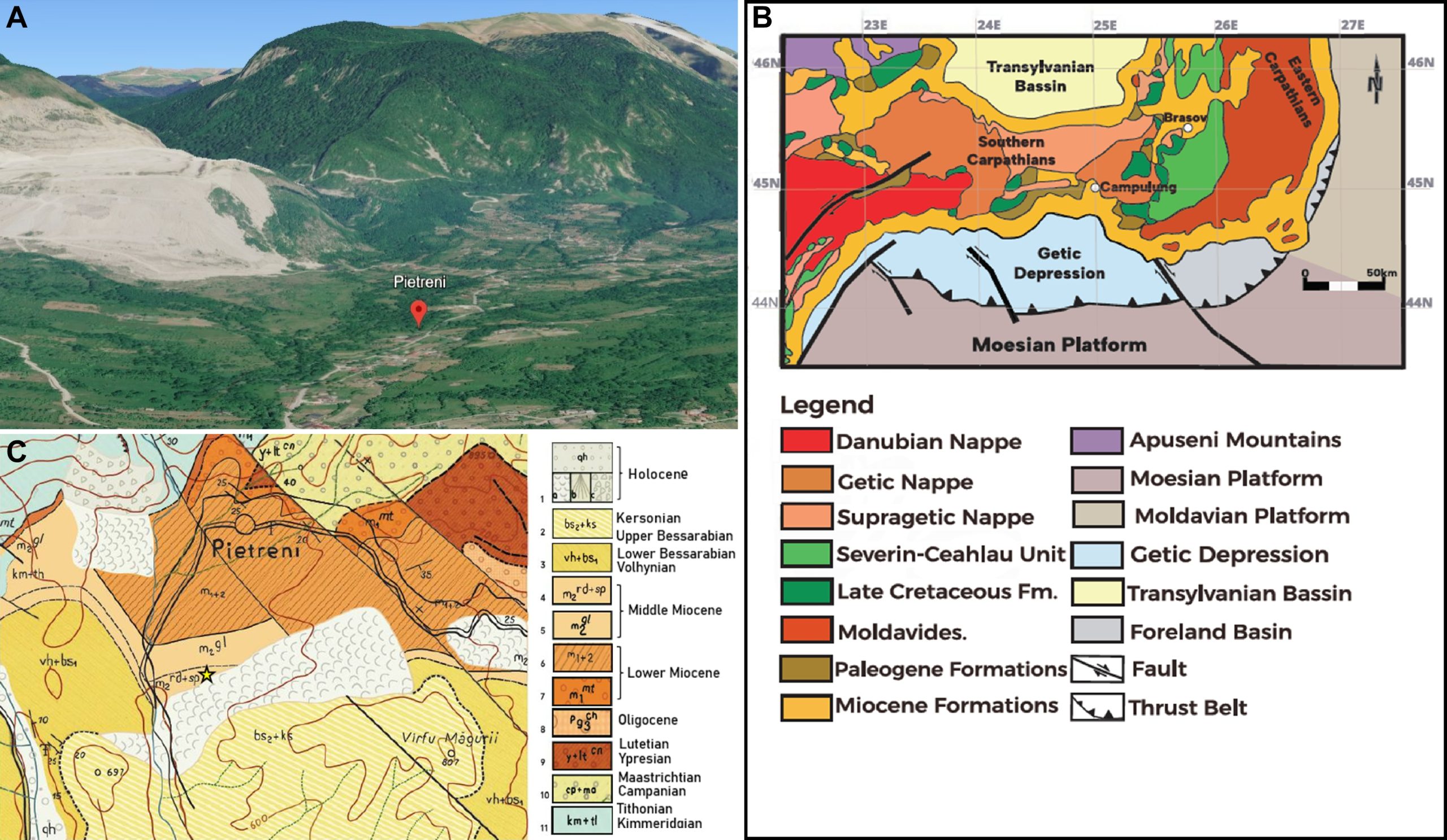
Figure 1. Geographic location and geological–tectonic setting of the Pietreni section, western Getic Depression, Romania. (A) Geographic position of the investigated section in the Pietreni area (Google Earth image). (B) Simplified tectonic framework of the Getic Depression and adjacent geological units, redrawn after Ghiran et al. (2023) and adapted from Săndulescu (1984) and Schmid et al. (2008). (C) Geological map of the Pietreni area showing the distribution of the main lithostratigraphic units and structural features, redrawn from the Vânturarița Geological Map (1:50,000 scale; Geological Institute of Romania, 1978).
A total of 24 samples were collected and analyzed, revealing a diverse microfauna dominated by radiolarians and accompanied by diatoms. Within this association, spumellarians are the most abundant and taxonomically diverse group, while nassellarians are represented by fewer taxa, many specimens displaying excellent preservation (Figs. 2-3).
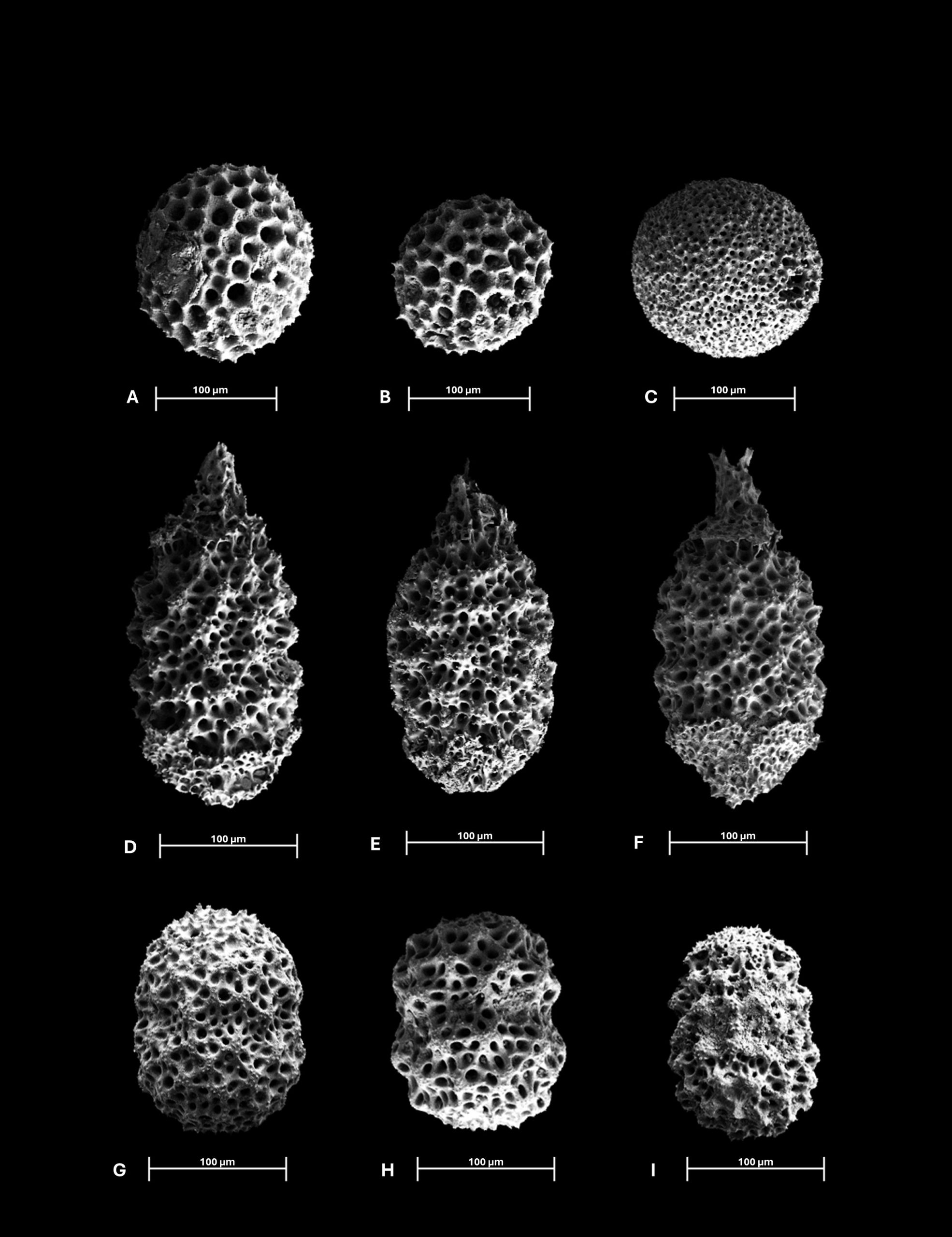
Figure 2. A-B.Excentrodiscus grigorei Dumitrică; C. Excentrosphaerella sphaeroconcha Dumitrică; D-F. Didymocyrtis laticonus (Riedel); G-I. Cyphonium virgineum Haeckel.
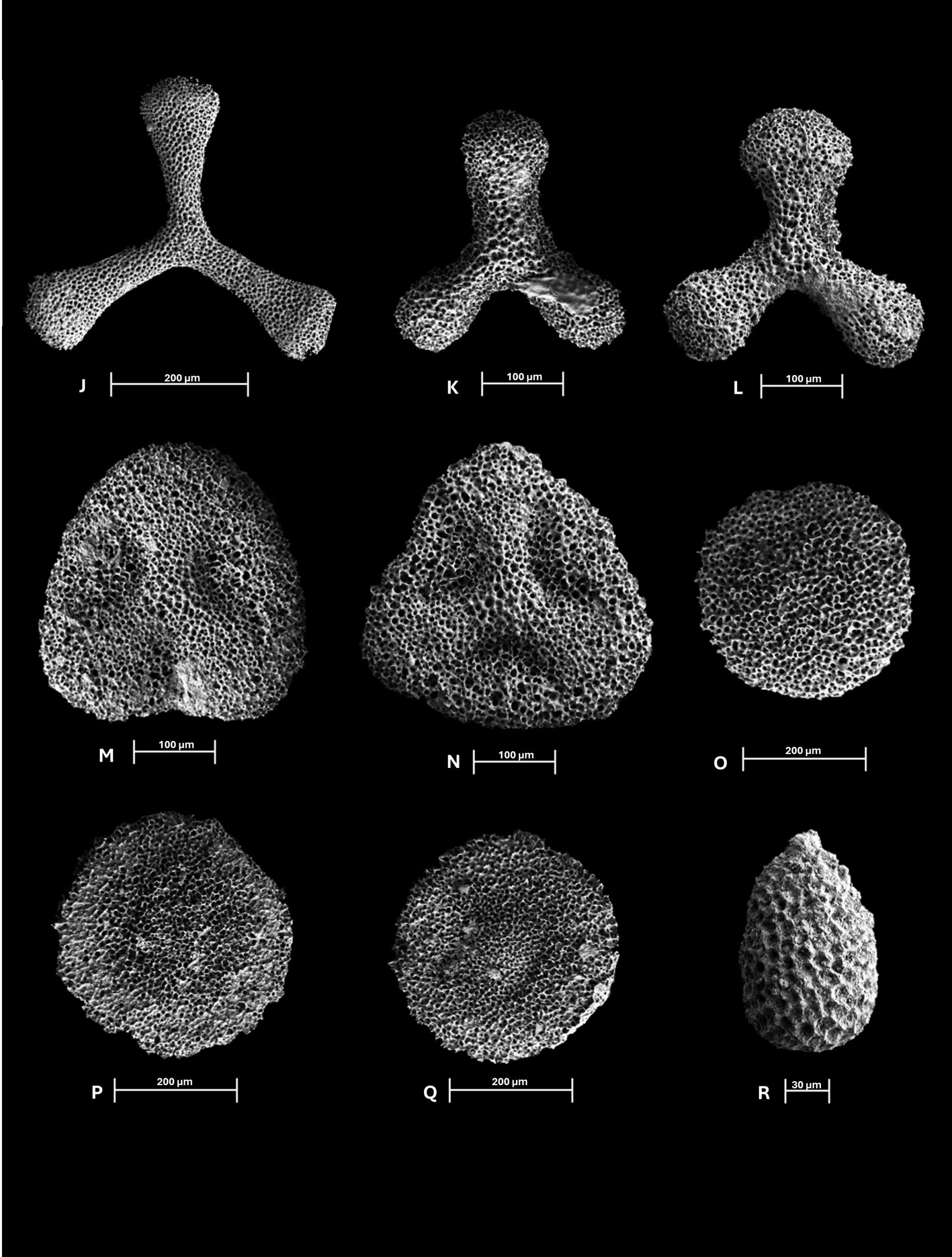
Figure 3. J-N.Rhopalastrum lagenosum Ehrenberg; O-Q. Schizodiscus disymmetricus (Dogiel); R. Lithopera sp.
The occurrence of species Didymocyrtis laticonus and Lithopera sp. supports the Late Badenian age for the studied section, corresponding to Zone RN5 (Riedel & Sanfilippo, 1970) emended by Riedel and Sanfilippo (1971, 1978) and Subzone RN5b (Kamikuri, 2022). Furthermore, the radiolarian association identified in the studied section shows strong affinities with radiolarian faunas reported from other localities in Romania and Poland (Dumitrică et al.,1975; Barwicz-Piskorz, 1999).
Beyond their biostratigraphic value, radiolarians provide a glimpse into the environmental conditions that existed during Late Badenian. Their abundance, together with the numerous volcanic tuff layers, points to an increased supply of silica that likely favored the development of siliceous microorganisms, while their stenohaline nature indicates the persistence of normal marine conditions (Dumitrică, 1968).
About the author
Emilia-Elena Nedelea holds a Bachelor’s degree in Geological Engineering and is currently an M.Sc. student in the Sedimentary Basin and Mineral Resources Assessment program at the Faculty of Geology and Geophysics, University of Bucharest. Her research interests focus on Cenozoic radiolarians, particularly those from the Miocene, and their applications in paleoecological and paleogeographic reconstructions.
References
Barwicz-Piskorz, W. (1999). Badenian Radiolaria from the Kraków area (South Poland). Annales Societatis Geologorum Poloniae, 69, 161-172.
Dumitrică, P. (1964). Asupra prezenței unor radiolari din familia Challengeridae (ord. Phaeodaria) în Tortonianul din Subcarpați. Studii si Cercetari de Geologie, Geofizica, Geografie, Seria Geologie, 9 (1), 217–222.
Dumitrică, P. (1965). Sur la présence de Phaeodaires fossiles dans le Tortonien des Souscarpathes roumaines. C. R. Acad. Sci. Paris, 260, 250–253.
Dumitrică, P. (1968). Considerații micropaleontologice asupra orizontului argilos cu radiolari din Tortonianul regiunii carpatice. Studii si Cercetari de Geologie, Geofizica, Geografie, Seria Geologie, 13 (1), 227–241.
Dumitrică, P. (2016) Middle Miocene (late Badenian) Phaeodaria from Romania. Acta Palaeontologica Romaniae, 22 (2), 3–20.
Dumitrică, P. et al. (1975). New data on the biostratigraphy and correlation of the Middle Miocene in the Carpathian area. Institutul de Geologie și Geofizică, Bucuresti. Dări de Seamă ale ședințelor, 61 (4), 65-84.
Ghiran, MD. et al. (2023). Thermal Maturity and kerogen type of badenian dispersed organic matter from the getic depression, Romania. Minerals, 13, 202. https://doi.org/10.3390/min13020202
Kamikuri, S. (2022). Tropical Radiolarian Biostratigraphy from the Early to Late Miocene at ODP Site 714 in the Tropical Indian Ocean. Paleontological Research, 26 (2), 187–212. https://doi.org/10.2517/PR200017
Kováč, M. et al. (2007). Badenian evolution of the Central Paratethys Sea: paleogeography, climate and eustatic sea-level changes. Geologica Carpathica, 58 (6), 579–606.
Olteanu, Fl. (1943). Observațiuni asupra “Breciei sării” cu masive de sare din regiunea mio-pliocenă dintre R. Teleajen si P. Bălăneasa (cu privire specială pentru regiunea Pietraru-Buzău. Dări de Seamă, Institutul Geologic, 32, 12-18.
Popescu, G. (1975). Études des foraminifères du Miocène inférieuret moyen du nord-ouest de la Transylvanie. Mémoires – Institutde Géologie et de Géophysique, 23, 1-121.
Popescu, Gr. (1951). Observații asupra “breciei sării” și a unor massive de sare din zona paleogenă-miocenă a județului Prahova. Dări de Seamă, Institutul Geologic, 32, 3-12.
Riedel, W. R. & Sanfilippo, A. (1970). Radiolaria, Leg 4, Deep Sea Drilling Project. In, Bader, R. G., Gerard, R. D. et al., Initial Reports of the Deep Sea Drilling Project, vol. 4, 503–575. https://doi.org/10.2973/dsdp.proc.4.124.1970
Riedel, W. R. & Sanfilippo, A. (1971). Cenozoic Radiolaria from the western tropical Pacific, Leg 7. In, Winterer, E. L., Riedel, W. R. et al., Initial Reports of the Deep Sea Drilling Project, vol. 7, 1529–1672. https://doi.org/10.2973/dsdp.proc.7.132.1971
Riedel, W. R. & Sanfilippo, A. (1978). Stratigraphy and evolution of tropical Cenozoic radiolarians. Micropaleontology, vol. 24, 61–96. https://doi.org/10.2307/1485420
Rögl, F. & Steininger, F.F. (1984). Neogene Paratethys, Mediterranean and Indo-Pacific Seaways. Fossils and Climate, 171–200.
Schmid, S. M. et al. (2008). The Alpine-Carpathian-Dinaridic orogenic system: correlation and evolution of tectonic units. Swiss Journal of Geosciences, 101(1), 139-183. https://doi.org/10.1007/s00015-008-1247-3
Săndulescu, M. (1984), Geotectonics of Romania. Technical Publishing House: Bucharest, Romania, 335.