
By Agata Jurkowska

My investigation focuses on the behavior of silica during early diagenesis in marine sedimentary systems by integrating mineralogical, petrographic and isotope-geochemical approaches applied to the geological record. It aims to identify the mechanisms controlling silica mobilization, precipitation, and phase transformations leading to the formation of siliceous rocks (flints and cherts) and carbonate-siliceous rocks (opoka, siliceous chalk), and to evaluate their implications for the long-term marine Si cycle.
The studies conducted by our team have demonstrated that silica diagenesis in marine sedimentary systems is considerably more complex than traditionally assumed. By integrating mineralogical, petrographic, and isotope-geochemical approaches, these studies have shown that silica mobilization, precipitation, and phase transformations are governed by the interplay between porewater evolution, seawater-derived dissolved silica (dSi), and local diagenetic conditions. These findings demonstrate that these processes are not controlled solely by the dissolution of biogenic silica from the skeletons of siliceous organisms, particularly siliceous sponges, which were the dominant biogenic silica producers during the Mesozoic.
A major outcome of our research has been the mineralogical redefinition of Upper Cretaceous opoka, a carbonate-siliceous rock first described from Poland (Pusch, 1836). We demonstrated that opal-CT is the diagnostic component distinguishing opoka from chalk and limestone (Fig. 1). In opoka, opal-CT constitutes the major component of the insoluble residue and forms a siliceous framework that becomes visible after dissolution of the carbonate fraction in hydrochloric acid. This work provided the first mineralogically based definition of opoka, establishing a robust framework for its international classification and demonstrating its significance as an archive of the marine Si cycle (Jurkowska et al., 2019; Jurkowska & Świerczewska-Gładysz, 2020a; Jurkowska, 2022).
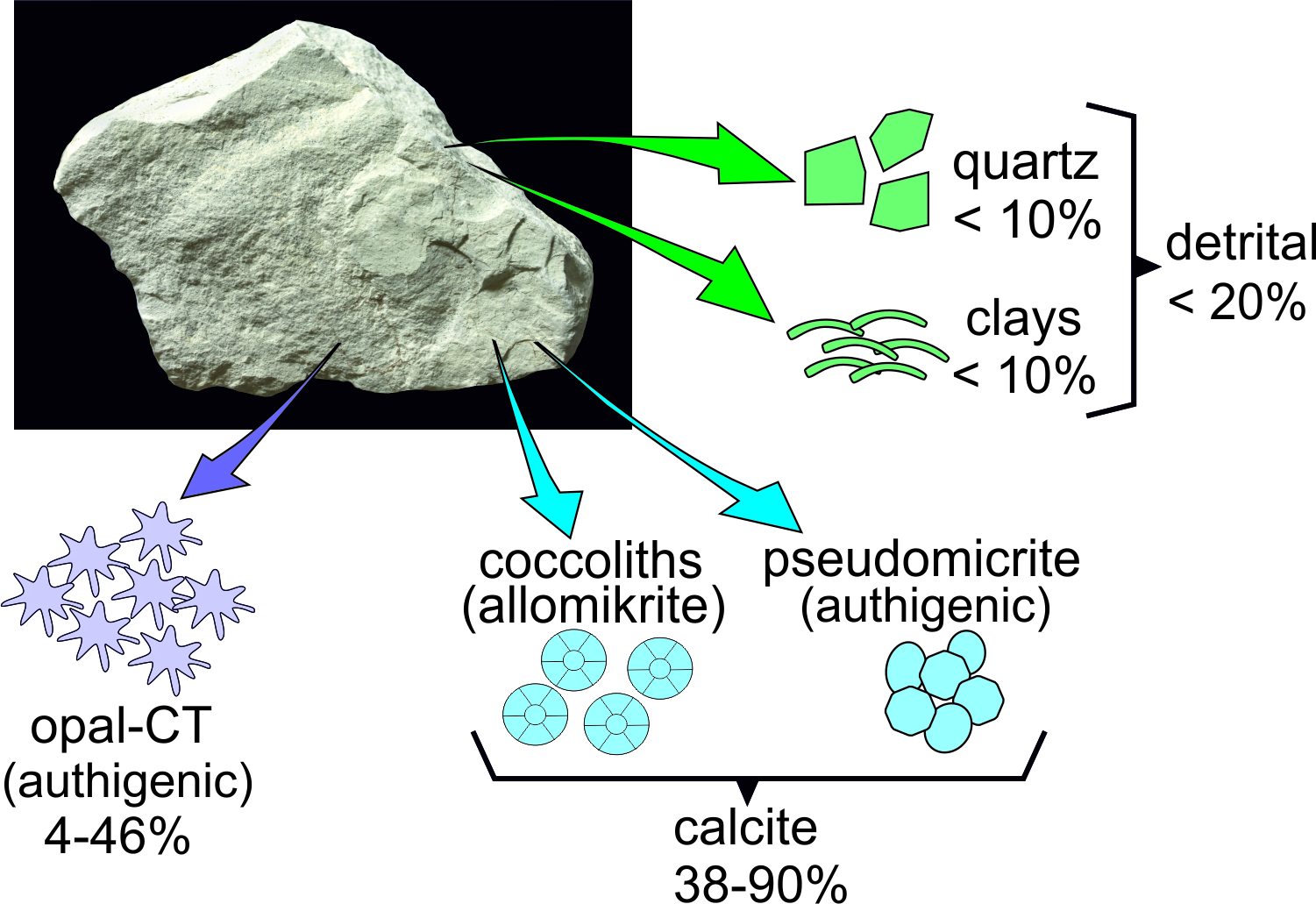
Figure 1. The mineralogical composition of opoka (from: Jurkowska and Świerczewska-Gładysz, 2022).
Moreover, based on detailed mineralogical and petrographic investigations, we proposed a new model of Si balance for the Upper Cretaceous European epicontinental basin (Fig. 2). Contrary to the prevailing view that siliceous sponges represented the dominant source of dSi responsible for the formation of siliceous rocks, our studies demonstrated that abiotic silica precipitation was widespread throughout the Palaeozoic and Mesozoic, and that seawater constituted the principal source of dSi (Jurkowska and Świerczewska-Gładysz, 2020a,b; Jurkowska et al., 2026). These findings challenged the traditional sponge-controlled model of silica diagenesis and highlighted the importance of inorganic silica precipitation in the formation of Upper Cretaceous siliceous rocks (particularly flints and cherts formation).
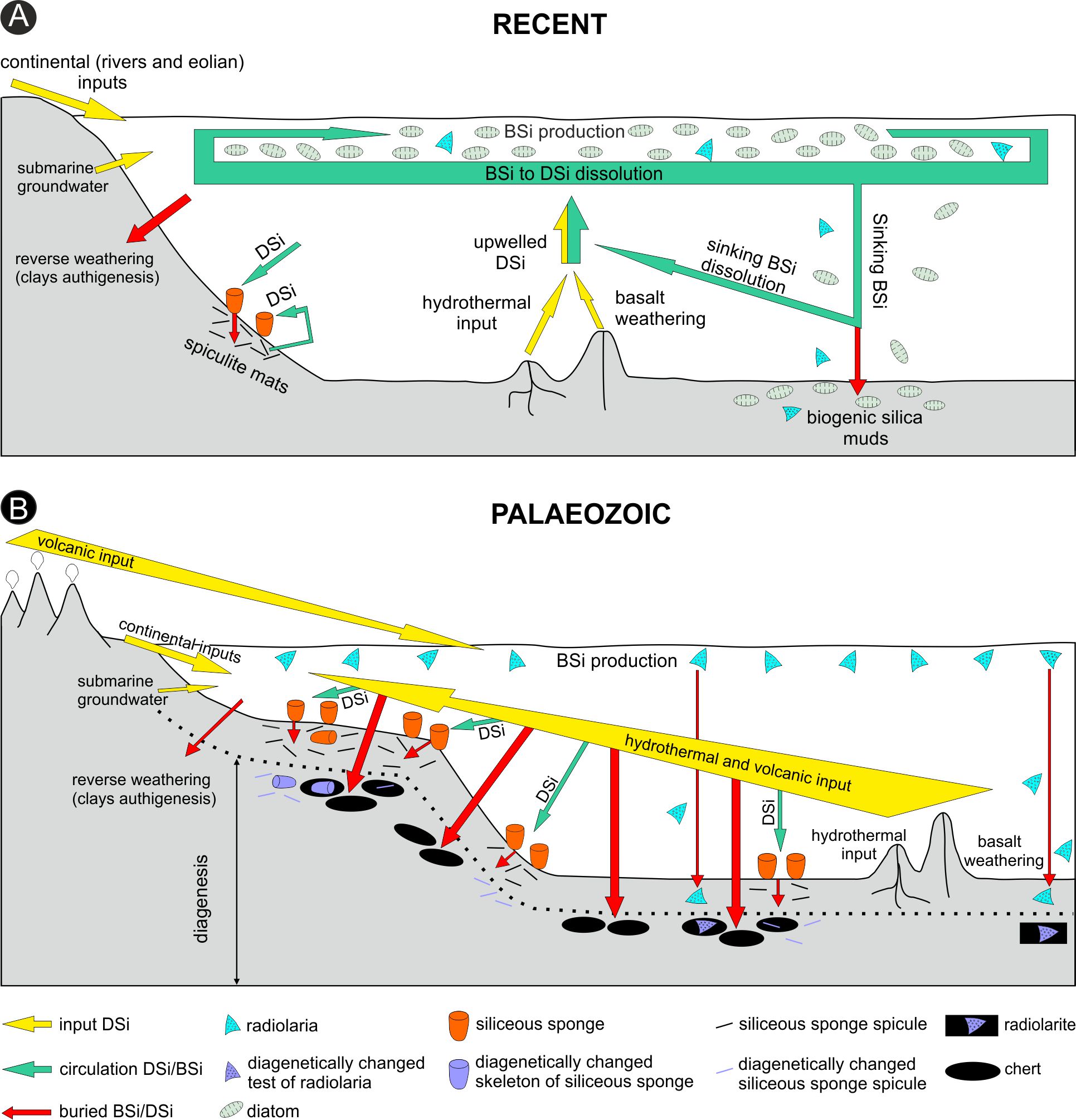
Figure 2. The comparison of recent and Palaeozoic/Mesozoic Si cycle in marine environments (from: Jurkowska & Świerczewska-Gładysz, 2024).
This revised concept of an abiotically controlled marine Si cycle also challenged the long-standing interpretation that the distribution of cherts throughout the Palaeozoic and Mesozoic primarily reflected the evolution and diversification of silicifying organisms. Based on a comprehensive review of the geological, mineralogical, geochemical, and paleontological literature, we demonstrated that periods of extensive flints formation were closely associated with enhanced volcanic and hydrothermal activity accompanying major tectonic and palaeogeographic reorganizations. Within this framework, biological evolution is interpreted as a secondary factor that modified, rather than independently governed, the marine Si cycle (Jurkowska & Świerczewska-Gładysz, 2024).
About the author
Agata Jurkowska is an Assistant Professor at the Faculty of Geology, Geophysics and Environmental Protection, AGH University of Krakow, Poland. Her research focuses on sedimentary geochemistry and the marine Si cycle, combining mineralogical, petrographic, and isotope-geochemical approaches to investigate silica diagenesis and the formation of siliceous sedimentary rocks. Her work aims to improve understanding of Si cycling and its links to long-term Earth system evolution. She is open to collaboration.
References
Jurkowska, A., Świerczewska-Gładysz, E., Bąk, M., & Kowalik, S. (2019). The role of biogenic silica in the formation of Upper Cretaceous pelagic carbonates and its palaeoecological implications. Cretaceous Research, 93, 170–187.
Jurkowska, A., & Świerczewska-Gładysz, E. (2020a). New model of Si balance in the Late Cretaceous epicontinental European Basin. Global and Planetary Change, 186, 103108.
Jurkowska, A., & Świerczewska-Gładysz, E. (2020b). Evolution of Late Cretaceous Si cycling reflected in the formation of siliceous nodules (flints and cherts). Global and Planetary Change, 195, 103334.
Jurkowska, A. (2022). The biotic-abiotic control of Si burial in marine carbonate systems of the pre-Eocene Si cycle. Global Biogeochemical Cycles, 36, e2021GB007079.
Jurkowska, A., & Świerczewska-Gładysz, E. (2022). Opoka – a mysterious carbonate-siliceous rock: an overview of general concepts. Geology, Geophysics and Environment, 48(3), 257–278.
Jurkowska, A., & Świerczewska-Gładysz, E. (2024). The evolution of the marine Si cycle in the Archean–Palaeozoic – an overlooked Si source? Earth-Science Reviews, 248, 104629.
Pusch, G.G. (1836). Geognostische Beschreibung von Polen, so wie der übrigen Nordkarpathen-Länder. Vol. 2. J.G. Cotta’schen Buchhandlung, Stuttgart–Tübingen.