The TMS Annual Conference 2026 will be hosted in Kraków, Poland, by the Polish Academy of Arts and Sciences, Micropress Europe, the Institute of Geological Sciences of the Polish Academy of Sciences, and the Grzybowski Foundation December 2-5th.
Second Circular link here.
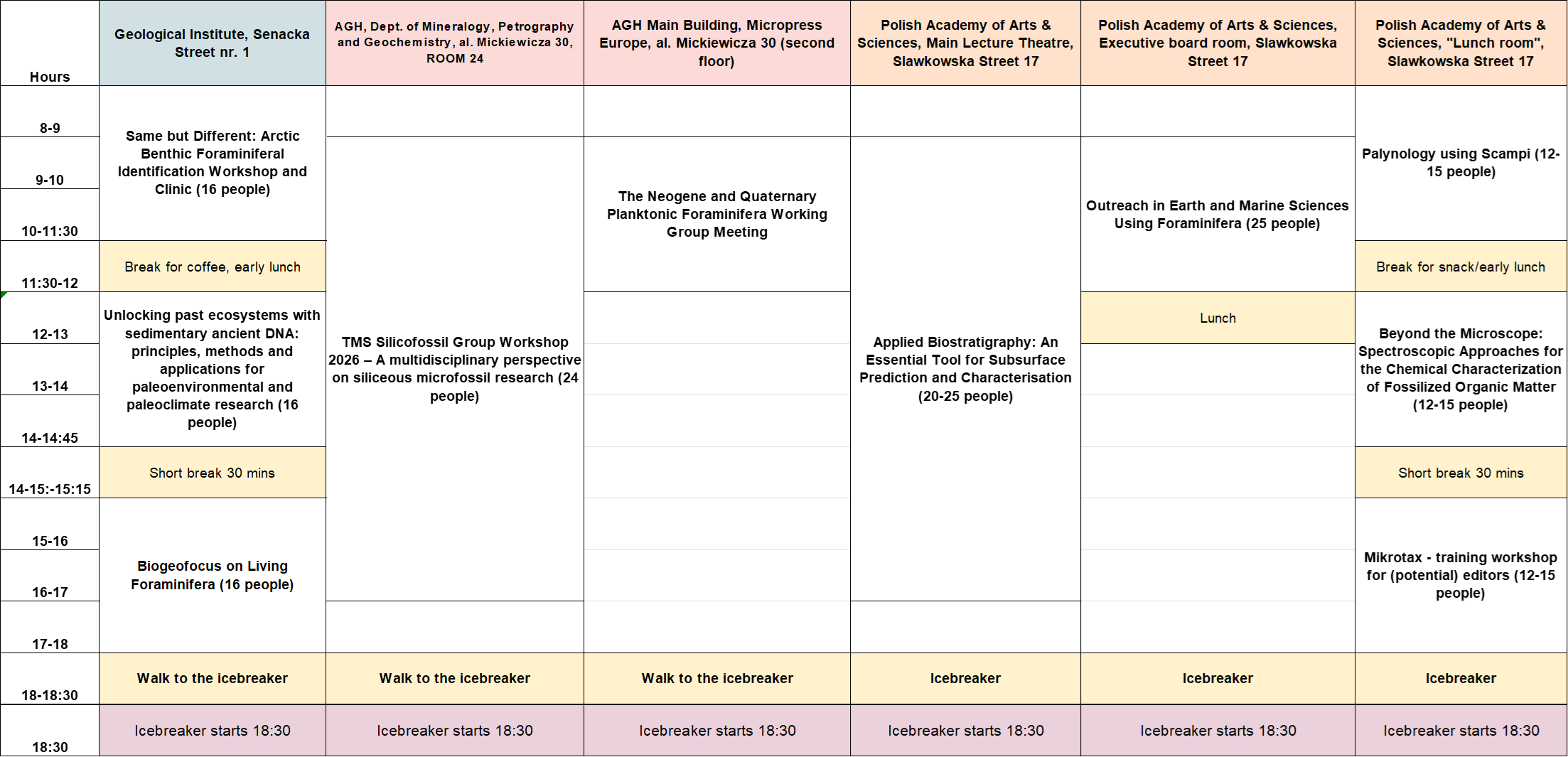
The AGM will start with an icebreaker at Micropress Europe on the evening of December 2nd, followed by two full days of scientific sessions and workshops at the Polish Academy of Arts & Sciences. On 5 Dec there will be an optional visit to collections at the European Micropaleontological Reference Center.
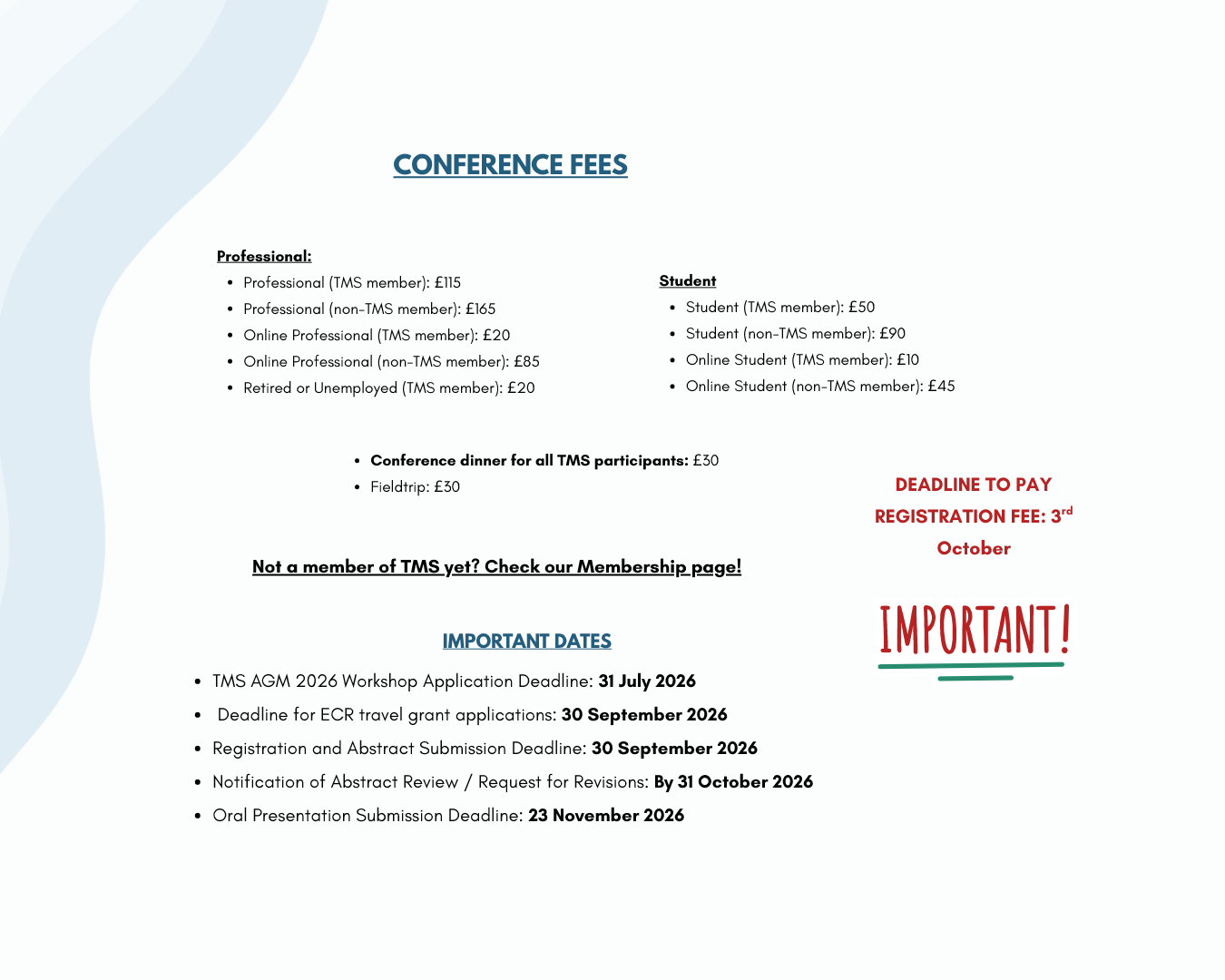
Registration fee includes access to all scientific sessions and workshops, conference materials, coffee breaks, lunches, icebreaker party. The trip (TBD) and conference dinner are paid separately.
The TMS AGM will be held on Thursday late afternoon and will be streamed. This portion of the meeting is free to all members and a zoom link will be circulated by the TMS secretary to all members in advance so that you may join. You do not need to register for the meeting if you will only be attending the AGM portion of the event.
TMS AGM 2026 – Online Registration
Online registration for the TMS Annual General Meeting 2026 in Kraków, Poland, is now open.
Registration period: 9 October – 14 November 2026
Online registration fees:
- Professional: £20 (TMS member) / £85 (non-member)
- Student: £10 (TMS member) / £45 (non-member)
- Retired or unemployed TMS member: £20
Online participation is limited to attending scientific sessions as a listener. Abstract submissions and online presentations are not available, and workshops will not be streamed. All sessions will follow Kraków local time (CET, UTC+1).
Register for online participation (link: https://forms.gle/cVLkZokSVWM4GkyHA)
Participants who have already registered and paid for online attendance do not need to register again.
For registration enquiries, please contact events@tmsoc.org or makaminski17@gmail.com. For payment-related enquiries, contact sarah.vinnell@petrostrat.com.
For more information click here.
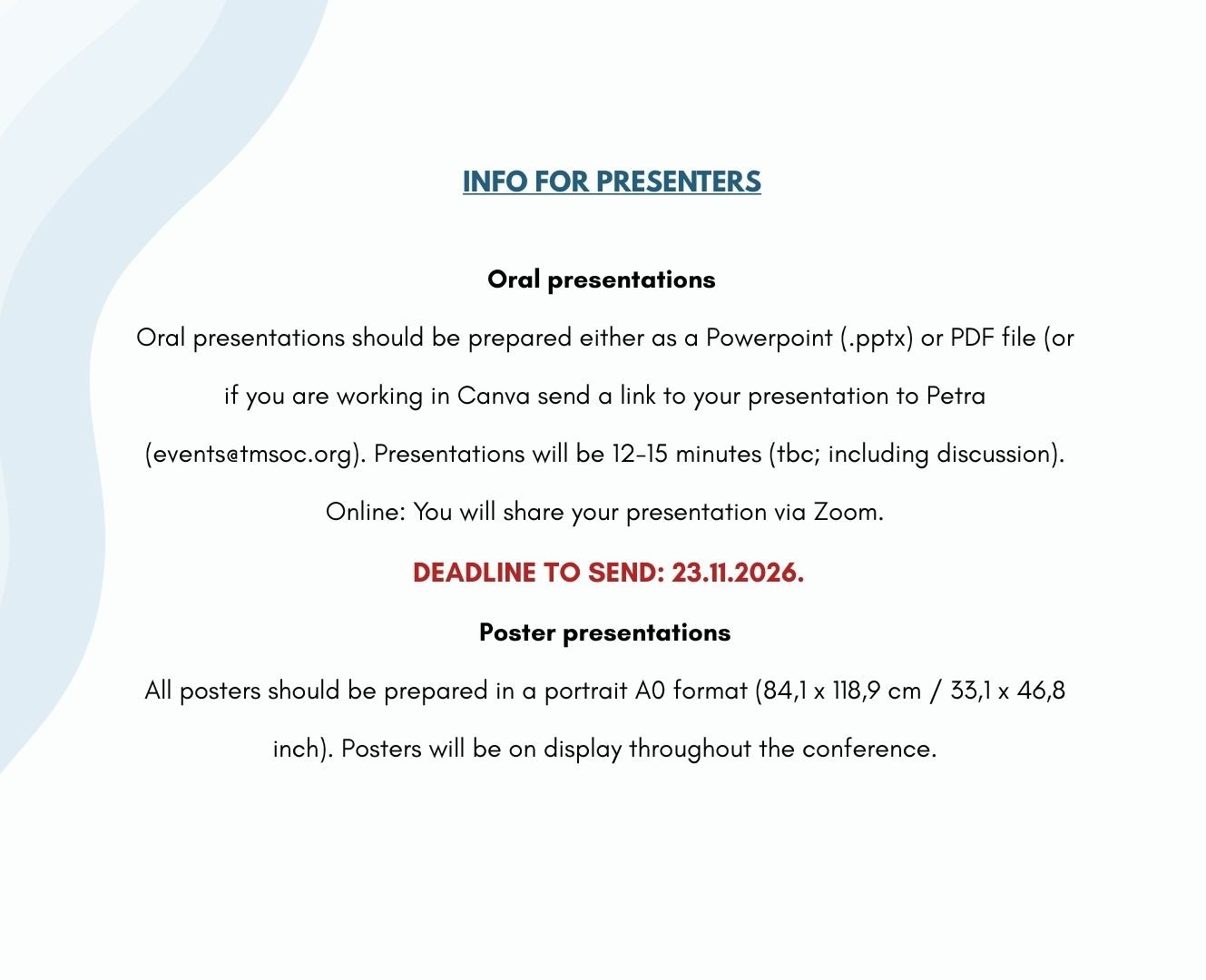
Abstract submission is open until 30th September, 2026.
Please apply here
TMS AGM Professional Registration:
TMS AGM Student Registration:
Workshops
Workshop registration will be open from 4–11 October 2026.
Places are limited and will be allocated on a first-come, first-served basis, so we recommend registering early.
https://forms.gle/gu4bRWiojanG7i488
Further details about the individual workshops, including their content, format and capacity, can be found below.
TMS Workshop Proposals
Outreach in Earth and Marine Sciences Using Foraminifera
Contact: Michael Hesemann, Foraminifera.eu Lab (hesemann@foraminifera.eu, www.foraminifera.eu)
Description
Outreach is essential for increasing the visibility of Earth and marine sciences, eventually helping to get better informed political decisions on the protection of our planet. This hands-on workshop will present practical approaches to science outreach in both real-world and virtual settings, showcasing examples of pop-up stands, interactive workshops for children and adults, online engagement, and social media activities. It will also demonstrate how outreach strategies can be tailored to effectively address different target audiences.
Participants will have the opportunity to present their own outreach activities and experiences, serving as a forum for discussion and the exchange of ideas. The aim is to lay the groundwork for a Practical Manual of Outreach Activities: for each activity, a standardized information sheet will be prepared, outlining its objectives, target audience, required equipment, sample material, and any accompanying resources.
The workshop will run in the standard interactive format, structured to facilitate engagement and in-depth discussion within the allotted 3-hour time frame.
Applied Biostratigraphy: An Essential Tool for Subsurface Prediction and Characterisation
Contact: Mike Simmons, Halliburton (mike.simmons@halliburton.com); Mike Bidgood, GSS Geoscience Ltd (mike@gssinternational.co.uk); Emma Sheldon, GEUS (es@geus.dk); Matt Wakefield, Lealt Stratigraphic Consultants Ltd (matthew.wakefield@lealt-strat.co.uk)
Description
The workshop covers key insights from biostratigraphy across seven themes: correlation and paleoenvironment as the two foundational pillars; organising the subsurface through sequence (bio)stratigraphy; predicting the subsurface and identifying new plays; characterising the subsurface at reservoir scale to enhance production decisions; operational biostratigraphy for real-time drilling decisions; digital biostratigraphy using AI-assisted data generation and interpretation; and the role of biostratigraphy in the energy transition.
These topics are discussed through short lectures, illustrated by practical, real-world exercises that vary in length and complexity depending on course duration. The approach is emphatically not about the fossils themselves — the course does not teach fossil recognition — but about what biostratigraphical data looks like to the non-specialist and how it can be productively used, since the applications of such data (correlation, palaeoenvironmental interpretation, etc.) are relevant to anyone investigating the subsurface.
Note: the organizers advise that a full day, rather than the standard 3 hours, is the minimum time required to complete the lectures and hands-on exercises plus discussion.
Palynology using Scampi
Contact: Paul Britton, StrataData Ltd. (paul@stratadata.co.uk, www.stratadata.co.uk); Rosa Townsend, StrataData Ltd. (rosa@stratadata.co.uk, www.stratadata.co.uk)
NOTE: Laptop required — Laptop or desktop computer with a good internet connection (software is cloud-based; no local install specified).
Description
Scampi is an innovative Machine Learning tool for palynologists, developed at Equinor and now commercially available through StrataData. The software is cloud-based. The workshop will present an overview of the workflow and then give participants access to demo data, guiding them through analysis and interpretation. Students will need a laptop or desktop computer with a good internet connection.
The session may not require the full 3 hours, depending on the audience. The organizers are not palynologists themselves, but an existing Scampi palynologist attending the TMS meeting may join to assist and answer more in-depth questions. A projector will be needed for the presentation.
TMS Silicofossil Group Workshop 2026 – A multidisciplinary perspective on siliceous microfossil research
Contact: Main organizers: Luca Pellegrino, Dept. of Earth Sciences, University of Turin, Italy (lu.pellegrino@unito.it); Marína Molčan Matejová, Dept. of Geology and Paleontology, Comenius University Bratislava, Slovakia (marina.matejova@uniba.sk). Co-organizers: Alexis Rodríguez-Jiménez, University of Costa Rica (alexis.rodriguezjimenez@ucr.ac.cr); Eleonora Santucci, Ca’ Foscari University of Venice / University of Pisa (eleonora.santucci@unive.it)
Description
The 2026 edition of the TMS Silicofossil Workshop aims to present and discuss relevant case studies and innovative analytical approaches in siliceous microfossil research. Through invited talks from lecturers with different expertise, the workshop will cover a broad spectrum of interests, giving attendees — particularly early career researchers — the chance to update their knowledge and interact with more experienced colleagues.
To improve the multidisciplinary nature of the initiative, four mid-career and senior researchers have been invited: Dr. Karen Gariboldi (University of Pisa) on paleoenvironmental reconstructions based on Quaternary diatom assemblages; Dr. Agata Jurkowska (AGH University, Kraków) on petrography and diagenesis of siliceous deposits; Prof. George Swann (University of Nottingham) on silicon isotope geochemistry; and Dr. Johan Renaudie (Museum für Naturkunde, Berlin) on big data analysis for studying siliceous plankton evolution.
Each lecture will be followed by a discussion between the speaker and attendees, facilitated by the organizers. The lectures on diatom taxonomy/paleoecology and on petrography/diagenesis will be in person, followed by interactive discussion coupled with microscopic observation of smear slides and thin sections. The lecture on big data analysis will likely be online, followed by a practical introduction to the main tools and scripts used for exploring virtual databases. The lecture on silicon isotopes will also be online, with no practical activity planned to follow. A definitive program will be available by the end of September; certificates of attendance will be released upon request.
Proposed format: the organizers request an extended time frame, ideally from 9:45 to 16:45, split into two parts with a lunch break. Preliminary timetable: 9:45–9:55 introduction; 9:55–10:25 talk on Si isotopes; 10:25–10:55 discussion; 10:55–11:05 coffee break; 11:05–11:35 talk on big data; 11:35–12:05 practical activity; 12:05–12:35 discussion; 12:35–13:35 lunch; 13:35–14:05 talk on diatom taxonomy/paleoecology; 14:05–15:05 microscope practical (smear slides); 15:05–15:35 talk on petrography/diagenesis; 15:35–16:35 microscope practical (thin sections); 16:35–16:45 concluding remarks.
Beyond the Microscope: Spectroscopic Approaches for the Chemical Characterization of Fossilized Organic Matter
Contact: Main organizer: Haidra Saleh, PhD, Postdoc Researcher, Dept. of Physics and Geology, University of Perugia (haidra.saleh@dottorandi.unipg.it). Co-organizers: Nicola Mitillo, PhD, Postdoc Researcher, Academic Laboratory of Basin Analysis (ALBA), Dept. of Sciences, Roma Tre University (nicola.mitillo@uniroma3.it); Elpiniki Maria Parparousi, PhD Candidate, Dept. of Physics and Geology, University of Perugia (elpinikimaria.parparousi@dottorandi.unipg.it)
Description
Fossilized organic matter has traditionally been studied using optical microscopy, which remains indispensable for taxonomic identification and palaeoenvironmental interpretation but cannot fully characterize the molecular composition of organic fossils or the chemical processes controlling their preservation, diagenesis and thermal evolution. Fourier Transform Infrared (FTIR) spectroscopy offers rapid, non-destructive chemical characterization that complements — rather than replaces — conventional microscopy.
Through presentations delivered by early-career researchers with expertise in different applications, participants will gain an overview of current methodologies, analytical capabilities and practical limitations of FTIR-based approaches across diverse paleontological contexts. The workshop opens with an introductory lecture on the principles of FTIR spectroscopy, including ATR-FTIR, transmission FTIR, micro-FTIR and emerging techniques such as Optical Photothermal Infrared (O-PTIR) microscopy, followed by invited presentations on chemotaxonomy, palaeoclimatic reconstruction, taphonomy, thermal maturity of organic matter, comparative case studies, and modern carbonaceous analogues such as biochar. A closing panel discussion and open forum will address methodological challenges, opportunities for interdisciplinary collaboration and future directions.
Proposed structure within the 3-hour slot: introduction to FTIR fundamentals (20–30 min); a practical session on spectral data processing and interpretation (20–30 min); three invited presentations (20–25 min each); and a discussion/Q&A session (30–40 min).
Learning outcomes: participants will understand the principles and capabilities of FTIR spectroscopy for analysing fossilized organic matter; recognize the advantages and limitations of different FTIR methodologies; evaluate where spectroscopic approaches can complement traditional paleontological techniques; identify suitable analytical strategies for their own research; and connect with researchers applying FTIR across paleontology and organic geochemistry.
Mikrotax – Training Workshop for (Potential) Editors
Contact: Jeremy Young, University College London (jeremy.young@ucl.ac.uk); David Lazarus, Museum für Naturkunde, Berlin (raddaveb@icloud.com)
NOTE: Laptop required — No specialist software needed — exercise data will be provided.
Description
The mikrotax system supports the websites Nannotax, pforams@mikrotax, bforams@mikrotax, radiolaria@mikrotax and Chitinotax, providing descriptions and illustrations of thousands of microfossil species that are freely used by scientists worldwide. This workshop provides background knowledge and hands-on experience of how the system works, for any micropalaeontologist interested in contributing to or editing existing sites (especially bforams@mikrotax and radiolaria@mikrotax) or developing new ones.
Draft outline: (1) an introductory lecture on how the site works, including database structure, software system and backend interfaces for editors; (2) practical editing experience, where participants are each given an editorial task — entering data, images and bibliographic data on a taxon — with scope for one-to-one discussion of plans and suggestions; (3) a workflow development session, discussing the need for efficient workflows and covering effective use of text editors (e.g. BBEdit, SublimeText), spreadsheets, and tools for extracting and editing images; (4) a closing group discussion.
Unlocking Past Ecosystems with Sedimentary Ancient DNA: Principles, Methods and Applications for Paleoenvironmental and Paleoclimate Research
Contact: Ana Gomes, NORCE (agom@norceresearch.no)
NOTE: Laptop required — R and RStudio must be installed beforehand. Installation instructions, example datasets and analysis scripts will be provided in advance.
Description
Sedimentary ancient DNA (sedaDNA) is transforming our ability to investigate past ecosystems, biodiversity dynamics and Earth system processes. Preserved within sediments, it complements traditional proxies by capturing signals from a wide range of organisms — including taxa that leave no fossil remains — enabling high-resolution reconstructions of ecosystem composition and biodiversity from less than one gram of sediment. Recent advances in molecular biology, high-throughput sequencing and bioinformatics have expanded its application from terrestrial archives and paleolimnology to marine sediments.
This workshop introduces the principles, methods, applications and future potential of sedaDNA as an emerging paleoenvironmental and paleoclimate proxy. Through presentations, a hands-on practical session and discussion, participants will gain an overview of the complete sedaDNA workflow — from study design and laboratory methods to bioinformatic analysis and ecological interpretation — as well as methodological challenges such as contamination control, DNA authentication and taxonomic assignment.
Structure: (1) Introduction (60 min) — fundamentals of molecular biology and sedaDNA, preservation/degradation/taphonomy, applications for reconstructing past biodiversity, available analytical tools and workflows, integration with traditional proxies, and methodological challenges. (2) Practical hands-on session (90 min) — participants analyze an example sedaDNA dataset in R, covering experimental design, bioinformatic processing, data visualization and ecological analyses (alpha/beta diversity, community composition, ordination), and interpretation within a paleoenvironmental context. (3) Discussion (30 min) — open questions, practical considerations, current challenges, future developments, collaboration opportunities and key take-home messages.
Practical requirements: a room with a computer, projector and internet access; participants should bring laptops with R and RStudio installed. Installation instructions, example datasets and analysis scripts will be provided in advance.
Learning outcomes: participants will understand the principles, potential and applications of sedaDNA as a paleoenvironmental proxy and how it complements traditional fossil and geochemical proxies; understand the main steps of a sedaDNA workflow; be able to perform basic exploratory analyses and visualizations of sedaDNA datasets in R; and gain knowledge of current approaches, methodological challenges and emerging research opportunities.
Biogeofocus on Living Foraminifera
Contact: Jan Goleń, Institute of Geological Sciences, Polish Academy of Sciences (ndgolen@cyf-kr.edu.pl); Michael Lintner, Institute of Geological Sciences, Polish Academy of Sciences (ndlintne@cyf-kr.edu.pl, www.ing.pan.pl/pracownicy/michael-lintner); Jarosław Tyszka, Institute of Geological Sciences, Polish Academy of Sciences (ndtyszka@cyf-kr.edu.pl, www.ing.pan.pl/pracownicy/jaroslaw-tyszka)
Description
Hosted at the Foraminarium in the heart of downtown Kraków, this intensive 3-hour workshop bridges cellular observation and geological proxy calibration, equipping researchers with advanced techniques for studying living foraminiferal physiology. Attendees will gain hands-on experience with high-resolution laser scanning confocal microscopy (Olympus FluoView 4000), designing experiments that integrate environmental chambers and perfusion systems with multi-target fluorescent staining. The workshop also covers Pulse-Amplitude Modulation (PAM) fluorometry to evaluate symbiotic algal health, concluding with practical modules on digital image deconvolution and quantitative data extraction. It is built around three core research pillars: morphogenesis and biomineralization (visualizing shell formation and structure at the subcellular level), biomonitoring and ecotoxicology (assessing real-time physiological responses to environmental stressors and pollutants), and palaeoenvironmental reconstruction (translating modern biological insights to refine deep-time climate proxies).
Format: (1) Presentations (1 hour) covering the principles of confocal microscopy, sample preparation best practices, multi-channel experiment design (selecting compatible fluorescent dyes, avoiding signal cross-talk), managing autofluorescence, and PAM-based chlorophyll fluorescence analysis. (2) Practical session (2 hours), in subgroups of about four people, covering fluorescent staining of benthic foraminifera (Calcein, Calcein AM, MitoTracker, SiR-actin, FM4-63) via manual pipetting and an automated perfusion system; optimizing microscope observation parameters; imaging stained specimens and natural autofluorescence of tests and symbionts; operating a microscope-mounted climate chamber to control temperature, CO2 and O2 during live-cell imaging; and applications of PAM from intracellular symbioses to pollutant interactions.
All materials and equipment will be provided using existing facilities at the Institute of Geological Sciences, Polish Academy of Sciences. Space is limited to 16 participants to ensure an interactive, collaborative environment.
Same but Different: Arctic Benthic Foraminiferal Identification Workshop and Clinic
Contact: Anna J. Pieńkowski, Dept. of Arctic Geology, UNIS, Norway & Geohazards Research Unit, Adam Mickiewicz University, Poland (annap@unis.no); Alix G. Cage, School of Life Sciences, Keele University, UK (alix.g.cage@keele.ac.uk); Paulina Romel, Geohazards Research Unit, Adam Mickiewicz University, Poland (paulina.romel@amu.edu.pl); Petra Hus, Dept. of Arctic Geology, UNIS, Norway (petrah@unis.no); Alasdair Morrison, School of Life Sciences, Keele University, UK (a.s.morrison@keele.ac.uk)
Description
This three-hour interactive workshop provides practical training in the identification of Arctic benthic foraminifera, focusing on morphologically similar taxa that are frequently confused or grouped together, including key representatives of Islandiella, Cassidulina and Elphidium.
The workshop opens with a 30-minute illustrated introduction to selected important Arctic taxa and the principal diagnostic features used to distinguish them — chamber arrangement, aperture, test shape, peripheral margin and surface ornamentation — with examples of why certain taxa are difficult to separate and when a cautious taxonomic assignment is more appropriate. An extended microscope-based practical session (~110 minutes) follows, in which participants examine and compare specimens with guidance from the workshop leaders; they are also invited to bring their own samples, slides, photographs or problematic specimens for an “Arctic Benthic Foraminiferal Clinic.” A 30-minute plenary discussion addresses specimens and identification problems encountered during the practical session, common sources of disagreement, and good practice for documenting and reporting taxonomic decisions. The workshop closes with about 10 minutes of summary remarks.
Requirements: transmitted-light stereo microscopes (preferably one per two to four participants), suitable working space, lighting and power outlets, plus a computer, projector and screen; a microscope-linked camera would be valuable for the introduction and plenary discussion.
Learning outcomes: by the end of the workshop, participants should be better able to recognise diagnostic features of selected Arctic benthic foraminiferal taxa, distinguish between commonly confused taxa, assess the level of confidence that can be placed in an identification, recognise when species-level identification is not justified, and report taxonomic uncertainty clearly and transparently.